
Reflections on My Practicum at the Constitutional Research Institute of the Constitutional Court of Korea
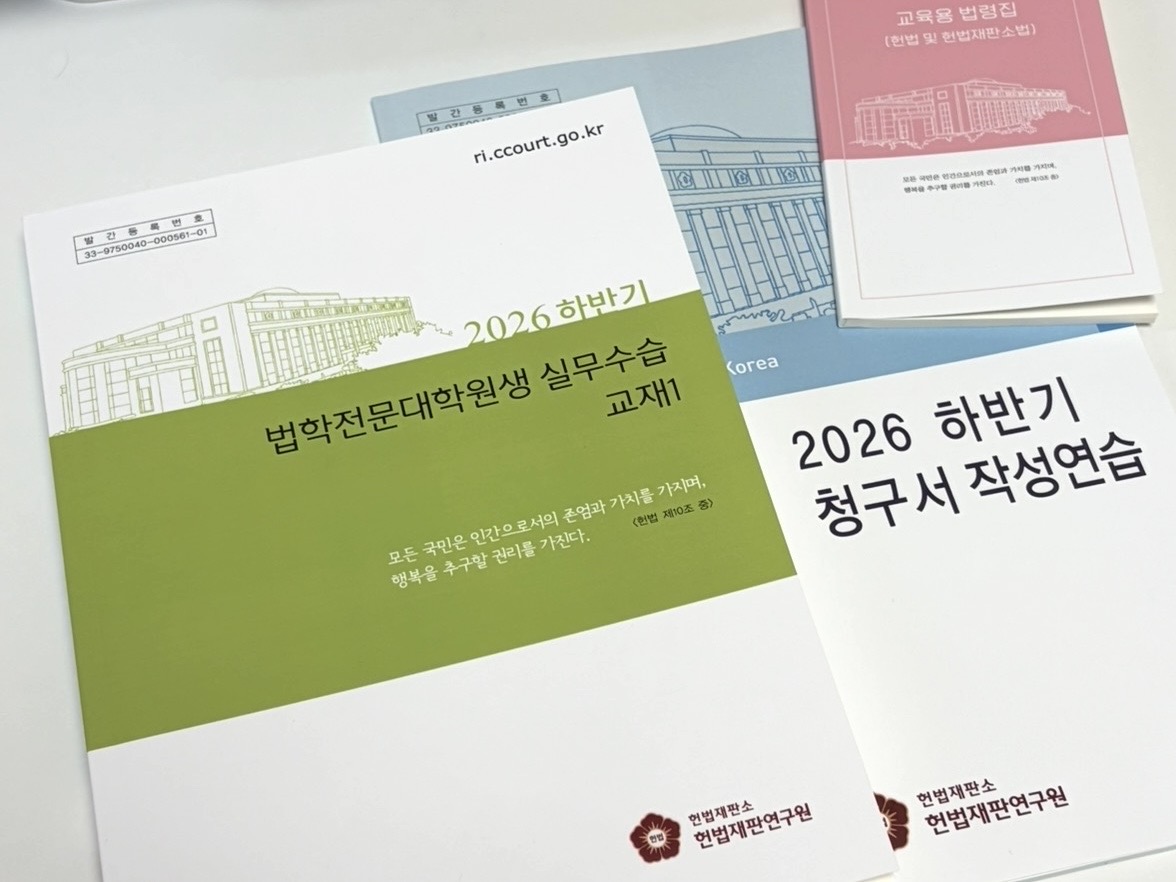
Practicum at the Constitutional Research Institute
The first summer break after entering law school turned out to be much shorter than I had expected. Finishing exams did not mean I could simply relax. There were courses to review, a new semester to prepare for, extracurricular opportunities to consider, and career questions that had begun to pile up. In the midst of all that, I was fortunate enough to be selected for the law school practicum program at the Constitutional Research Institute of the Constitutional Court of Korea.
The program lasted two weeks. Giving up a meaningful portion of an already short break was not a small decision, but as someone with a genuine interest in constitutional law, it was not an opportunity I could easily pass up. It offered the chance to study constitutional adjudication not only through textbooks and casebooks, but from the perspective of the Court that actually researches and decides constitutional cases. From June 29 to July 10, 2026, I spent two intensive weeks learning how constitutional litigation is handled at the Constitutional Court and its Research Institute.
Relearning Constitutional Litigation from the Court’s Perspective
On the first day of the practicum, I attended a lecture on the organization of the Constitutional Court and its adjudicatory procedures. I was particularly struck by the explanation that constitutional adjudication serves two functions at once: it provides relief for violations of individual fundamental rights, while also safeguarding the objective constitutional order. A case that begins with one person seeking relief can ultimately lead to legislative reform or the creation of an entirely new institutional framework. That possibility made me reconsider the distinctive social significance of constitutional adjudication, which differs in important ways from ordinary civil or criminal litigation.
The lectures that followed covered the Court’s major forms of jurisdiction in detail: constitutional review of statutes (Hun-Ka), constitutional complaints under Article 68(1) (Hun-Ma) and Article 68(2) (Hun-Ba) of the Constitutional Court Act, and adjudication on competence disputes (Hun-Ra). Rather than simply memorizing statutory provisions and doctrinal elements, we focused on which procedure should be selected in an actual case, how the subject matter of review should be identified, and at what stage a petition might be dismissed as inadmissible. In Hun-Ma cases, I learned the importance of whether the claimant is personally and directly affected, whether the infringement is present, whether other remedies have been exhausted, whether the filing period has been observed, and whether a continuing legal interest in relief remains. In Hun-Ka and Hun-Ba cases, I saw how crucial it is to establish the challenged statute’s relevance to the underlying proceeding and to identify the exact statutory language subject to review.
In law school classes, we often study constitutional decisions by concentrating on the holding or the governing doctrine. During this practicum, however, I was able to examine much more closely how the Constitutional Court actually organizes a case, which admissibility requirements it reviews before reaching the merits, and how it determines which part of the claimant’s arguments will become the subject matter of adjudication. I found it especially interesting that the fate of the same underlying dispute may depend on whether it is brought as a Hun-Ma or Hun-Ba case, or whether administrative litigation must be pursued first.
From Admissibility to the Merits
The lectures on merits review were equally valuable. We revisited the four-part proportionality test: legitimacy of purpose, suitability of means, least-restrictive means, and balance of interests. More importantly, I learned what kinds of evidence and arguments are actually required at each stage in constitutional adjudication. In particular, the least-restrictive-means inquiry cannot end with the bare assertion that “a less restrictive alternative exists.” The alternative must be examined in concrete terms: whether it is realistically available, whether the existing measure is genuinely effective, and what practical consequences or unintended effects each approach may produce.
The equality principle likewise showed how much the intensity and outcome of review can depend on the choice of comparator groups. Through a range of decisions, we considered whether groups that are essentially alike were being treated differently, which comparison would best reveal the real constitutional issue, and whether arbitrariness review or a more demanding proportionality analysis should apply. We also studied the clarity principle, the prohibition against blanket delegation, the principle of reservation by statute, the protection of legitimate expectations, and proportionality between culpability and punishment. These lectures made clear that merits review in constitutional adjudication is not an abstract exercise in value judgment, but a disciplined process grounded in carefully structured standards and extensive research.
What I appreciated most was the opportunity to learn how a case is approached from the perspective of the Constitutional Court and its Constitutional Rapporteur Judges, the Court’s specialist legal research officers. Their work does not stop at organizing the arguments submitted by the parties. They investigate the institutional background of the dispute, legislative history, relevant precedent, comparative law, and the broader social consequences of a possible decision. We were told that admissibility questions and legal issues that may appear only briefly—or not at all—in the final decision are examined in depth in internal research memoranda, then refined through discussion among rapporteur judges and deliberation by the Justices. Hearing about that process gave me a glimpse of how rigorous the Court’s internal research and reasoning can be.
My First Record-Based Assignment: A Petition and a Supplemental Brief
The individual assignment was to draft a petition for a constitutional complaint under Article 68(2) of the Constitutional Court Act and a supplemental brief addressing the admissibility requirements of an Article 68(1) constitutional complaint. For me, this was essentially my first record-based legal writing assignment built around a closed case file. Unlike a traditional hypothetical exam answer, where the task is to identify issues and state the governing rules, this required me to organize scattered facts chronologically, define the subject matter of review with precision, and connect admissibility and merits arguments within a single coherent filing.
Because I wanted to produce a strong petition, I stopped by the law school library after class and borrowed additional books on record-based legal writing. I compared the structure of Constitutional Court decisions with sample petitions, checking one point at a time: how the prayer for relief should be written, which background facts had to appear in the statement of the case, and what materials were needed to establish the statute’s relevance to the underlying proceeding and compliance with the filing period. I revised individual sentences repeatedly so that the requested relief, the subject matter of review, the fundamental rights at issue, and the grounds for the petition would remain consistent throughout.
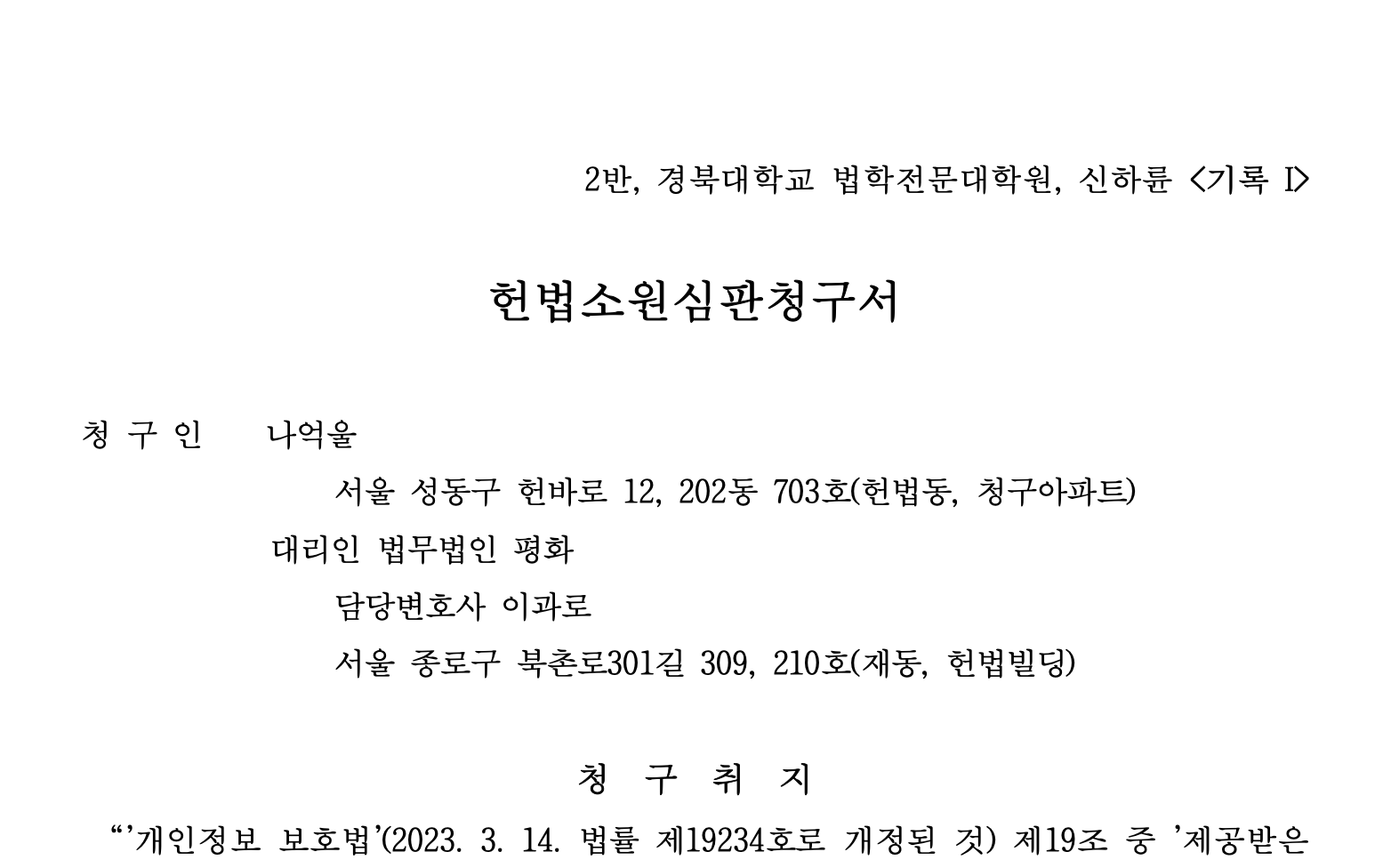
Through this process, I learned that knowing the doctrine and translating that doctrine into a persuasive legal filing are entirely different skills. Admissibility requirements are not boxes to be checked mechanically. They form the logical path that allows a case to reach constitutional review on the merits. I also came to understand that merits arguments should not begin with a predetermined conclusion followed by a list of doctrines. They must grow out of careful research into the structure of the relevant institutional framework, the available materials, and the applicable standards of review. The assignment felt daunting at first, but by the time I submitted it, I was much less intimidated by record-based legal writing, and the structure of constitutional litigation filings had become far clearer to me.
Leading the Unconstitutionality Team in 2023Hun-Ka20
The group assignment was to prepare a research report on the Constitutional Court’s March 26, 2026 decision in Case No. 2023Hun-Ka20. Each class was divided into a team defending the provision’s constitutionality and a team arguing that it was unconstitutional, and I served as the leader of the unconstitutionality team. The assignment was not simply about reaching a preferred conclusion. What mattered was how thoroughly we could investigate and connect the case’s institutional background, subject matter of review, relevant precedent, applicable standards, and the arguments for and against constitutionality.
At first, my biggest concern was how to turn research produced by several people into one coherent report. I therefore built a Google Drive-based collaboration system with a shared folder and working documents, then organized each member’s assigned section and deadline. Sources could be uploaded and circulated immediately, while drafts and bibliographies remained visible to the entire team. We used document comments together with a group chat whenever an issue required quick discussion. This helped everyone work independently without losing sight of the shared research direction, and it allowed us to identify overlapping work and missing issues relatively early.
We divided the research sections in advance and completed our individual drafts by the day before the deadline. Every member actively searched for materials and offered ideas, and I learned a great deal simply by reading the sections written by the others. Precedents and arguments I had not considered continued to emerge, and our constitutional objections became more refined as we reviewed one another’s writing. Group projects sometimes end as little more than a division of labor, but this one involved genuine sharing of research and sustained discussion, and each member’s contribution was meaningfully reflected in the final report.
On July 9, the submission deadline, I collected all of the individual drafts and consolidated them into a single final document. I standardized the writing style, terminology, footnote format, and table-of-contents structure, and I also prepared the appendices and cleaned up the bibliography. Making work written by several different people read like one report required more time than I had expected, but it was also the part of the project from which I learned the most as team leader. Even a strong individual argument loses persuasive force if it does not occupy the right place within the overall structure.
I also designed the presentation deck myself. Rather than simply transferring the report onto slides, I drew on the restrained colors and visual elements used in the Constitutional Court’s official materials so that the presentation would feel consistent with the institution’s own visual language. I organized the slides so that the case background, subject matter of review, major issues, arguments for unconstitutionality, and conclusion could be understood at a glance. Team members reviewed the sections they had worked on and left revision comments, which helped us complete a polished presentation. Thanks to everyone’s active participation, both the report and the slide deck reached a level with which I was genuinely satisfied.

On the final day, the constitutionality and unconstitutionality teams presented their research to one another. Even in the same case, the outcome could change depending on how the subject matter of review was framed, how much legislative discretion was recognized, and which standard of review was selected. Our presentation concluded successfully, with each member explaining the section they had handled, and listening to the other team also gave me the chance to reconsider both sides of the constitutional debate.
A Closer Look at the Work of Constitutional Rapporteur Judges
During the practicum, we also had opportunities to hear directly from a senior researcher at the Constitutional Research Institute and a Constitutional Rapporteur Judge who participates in adjudication at the Constitutional Court. They explained the workflow behind preparing research reports, discussing cases among rapporteur judges, supporting the Justices’ deliberations, drafting decisions, and preparing official case reports. I was struck by the fact that major cases may require sustained attention to a single issue over a long period, and that substantial follow-up work continues even after a decision has been announced.
The work of a Constitutional Rapporteur Judge seemed to involve much more than mechanically applying statutory language. It requires asking whether that language remains consistent with constitutional values and with the society in which it operates today. For a single case, rapporteur judges may read, write, and debate not only statutes and precedents, but also institutional history, social context, comparative materials, and possible policy alternatives. In that sense, it felt like a role in which the intellectual appeal of constitutional law—the subject that has interested me so deeply—could be experienced in its most concentrated form.
I also remember watching recordings of public oral hearings and examining the Court’s strong practice of ex officio review. The Court does not reach a conclusion solely within the four corners of the parties’ submissions. It may actively identify additional materials and issues, and in socially significant cases it uses public hearings to hear a wider range of views. Studying the conscientious-objection cases and the introduction of the alternative service system reminded me that a constitutional decision can extend beyond one individual dispute and produce real changes in law and public institutions.
Closing Thoughts
Two weeks was a short period, but I learned a remarkable amount. I was able to organize my understanding of the principal forms of constitutional litigation, the requirements for admissibility, the precise identification of the subject matter of review, and merits standards such as proportionality and equality. Most meaningful of all was learning not merely to read the conclusion printed in a decision, but to ask what facts were investigated, which arguments were compared, and what counterarguments had to be addressed before the Court could reach that conclusion.
Through the individual assignment, I completed a constitutional litigation filing based on a closed record for the first time. Through the group assignment, I experienced the full process of researching a legal issue with others and turning that work into one report and one presentation. I learned that producing strong legal writing alone is not enough. It is equally important to share a research direction, listen carefully to other people’s views, collaborate without losing coherence, and raise the quality of the final product as a whole.
A law student’s break is genuinely short. There is always more to do, and there is also a strong desire simply to rest. Even so, for anyone with a serious interest in constitutional law, I believe these two weeks are well worth making time for. The program offers a rare opportunity to see how the constitutional law learned in textbooks actually operates through cases, written submissions, research, and debate.
By the end of the practicum, I had come to think that constitutional adjudication is ultimately the work of deciding whether a single sentence of statutory text is constitutional by considering, at the same time, human lives, institutional design, and the direction of society. Closely examining admissibility, weighing competing values on the merits, and thinking through the social consequences of a decision are all part of making the Constitution function in the real world.
I was fortunate to receive this two-week opportunity, but I do not think what I learned will remain a matter of luck. As I continue studying constitutional law and writing legal documents, I hope to remember the habits emphasized throughout the practicum: precise issue framing, deep research, and rigorous legal reasoning.