
In an Age When AI Seems to Do Everything, I Asked What Remains Human.
Reflections on the First Law School AI Challenge
When I had just finished my first semester of law school, I entered the First Law School AI Challenge with a friend. At first, judging from the name alone, I thought it would be a competition about using AI well to produce something like the case analysis or record-based answers we write in law school. But once I opened the problem set, I realized that the competition was asking something much deeper. In an age when legal professionals use AI as a tool, what can we do faster? What must we verify more carefully? What kinds of abilities should students cultivate? And above all, what kinds of judgment can only a human being ultimately take responsibility for?
The competition was co-hosted by the Korean Association of Law Schools, the Law Times, Law&Company, and LBOX. It brought together law students from across Korea to test both their ability to use AI and their capacity to solve legal problems. Participants went through a preliminary round, a main round, and a final round. The task was not to display memorized legal knowledge. It was to respond as if we were handling a real client matter, using AI to analyze legal risk and draft a professional legal opinion.
The first stage, the online preliminary round
The first stage was an online preliminary round. My friend and I met in Daegu, opened our laptops, and logged in together. More than 900 law students from across the country had applied to participate, and 265 teams ultimately submitted answers within the allotted time. Only 150 teams would advance to the main round.
Before the round began, I had little sense of what the problem would look like. I expected something closer to what we see in law school exams, perhaps a fact pattern followed by an instruction to draft a complaint or write a legal memorandum. In reality, the task felt much closer to practice. A fictional fintech startup CEO had sent an urgent email requesting legal advice, and we had two hours to respond as the company’s counsel. We had to review financial regulation, personal data issues, GDPR, and data breach response. This was not an exam where one recites statutes and precedents from memory. We had to use AI, find the necessary materials, verify the answers, and turn them into something a client could actually receive and act upon.
I was a little thrown off at first, but once we began, I found it genuinely interesting. When AI produced a draft, we had to ask whether it was really correct. We had to look for missing issues, remove exaggerated language, and think about what the client needed to do right away. Two hours was painfully short, but with legal AI tools we were able to submit an answer that we were reasonably satisfied with. More than anything, I began to understand that this was not simply a contest about using AI. It was a contest about the mindset and practical sense of a legal professional who works with AI.
The second stage, the main round
A few days later, I saw our team name on the list of teams advancing to the main round and headed to Seoul with a good feeling. The main round was held at the aT Center in Yangjae. When I entered the hall, rows of laptops had been set up, and law students were taking their seats by team. The atmosphere was completely different from the online preliminary round. Just being in the same space with hundreds of people preparing to solve the same kind of problem at the same time created a kind of tension that was hard to ignore.
In the main round, six high-level, practice-based problems had been prepared by major law firms, including Kim & Chang, Lee & Ko, Bae, Kim & Lee, Shin & Kim, Yulchon, and Yoon & Yang. Each team was randomly assigned one of the problems. Participants had to complete their answers within the time limit using legal AI tools such as LBOX, SuperLawyer, and Ailex. As in the preliminary round, this was not an exam where one could simply submit whatever AI had written. The human role was to verify, structure, and transform AI outputs into a practical document for a client.
Our team received Problem 5. Until the results were announced, we did not know which law firm had written which problem.
Only later, after learning that the problem had been prepared by Bae, Kim & Lee, did I notice the hint hidden in the fictional company’s name: Pacific Mobility. “Pacific” is the meaning of Taepyeongyang, the Korean name of the firm. It was a clever touch.
Problem 5 covered M&A, AI, personal information, and National Assembly audit response. The time limit was only three hours. The fictional listed company, Pacific Mobility, was planning to acquire the aviation business of its 75 percent subsidiary, Centropolis Airlines. At the same time, it had to respond to allegations of discrimination involving an AI hiring evaluation solution and to a request for materials from the National Assembly. We also had to submit not only the final answer but a statement explaining how we had used AI. The instructions made clear that if we submitted AI-generated results without review, our score for AI strategy would be reduced to zero.
To be honest, I felt overwhelmed at first. I had just finished one semester as a first-year law student, and yet the problem asked us to review M&A, aviation business law, antitrust law, capital markets regulation, personal information protection law, AI regulation, equal employment law, and National Assembly audit response all at once. On top of an imminent M&A transaction, the company’s hiring AI had automatically rejected more than 25,000 out of approximately 38,000 applicants. If the company wanted to close the transaction smoothly, government approval would likely be necessary. But now a discrimination issue had emerged, so an integrated response was required. In other words, we had to handle corporate law issues related to an acquisition, analyze international aircraft lease contracts, review compliance with data protection law, and respond to a National Assembly audit and a civil society press conference. It was, naturally, not an easy task.
Still, as we had done in the preliminary round, we divided our roles and began working. My friend quickly started the legal research and organized relevant statutes, precedents, and regulatory issues into a working document. My role was to build the overall structure of the answer based on those materials, make the final judgment on each issue, and refine the document into the final submission. In this process, legal AI tools such as SuperLawyer and LBOX were astonishingly powerful. They helped us find contradictions across a large body of materials, propose a structure quickly, and remind us of legal issues we might otherwise have missed.
At the same time, however, the answers produced by AI were never finished products that could simply be submitted. As we wrote in our AI usage statement, we uploaded the materials to tools with RAG functions, asked follow-up questions based on issues we had identified ourselves, reviewed and summarized the outputs, and then moved them into an internal research document. We also had to re-check cases and statutes suggested by AI. Where the problem materials contained inconsistent facts, a human being still had to decide what to make of them. AI had no shortage of fast answers, but an answer that one can take responsibility for is something else.
The most important thing was not to write what sounded favorable to the client. It was to write what would actually help the client. For example, in response to the National Assembly’s request for materials, it would have been easy to say that the company should refuse everything on the grounds of personal information and trade secrets. But we saw that as a practically dangerous response. Instead, we proposed submitting necessary materials while adjusting the form of disclosure through pseudonymization, redaction, summaries, sample submission, and on-site inspection. At the same time, we advised the client to correct inconsistencies between its public notices and actual operations regarding overseas transfer, retention periods, and automated decision-making. As for the hiring AI, we proposed an action plan that included suspending the Auto Non-Pass function or requiring human review, treating FaceVector as sensitive information and preparing a separate notice and consent framework, and conducting an external bias audit.
After submitting the main-round answer, my hands were shaking. In three hours, we had read, judged, discarded, and rewritten far too much. But once we finished and stepped out of the hall, I felt strangely relieved. My friend and I had a good meal, rested, and went our separate ways. Still, the day before the results were announced felt much too long.
The next day, the 12 teams advancing to the final round were announced first. The top two teams for each problem advanced to the final, and the highest-scoring team for each problem would receive an excellence award for the main round. We did not, however, know whether we had won that award until the final awards ceremony. When I saw our team name on the list of finalists, I was genuinely excited. The mere fact that I would meet my friend again at the aT Center seemed to release all the tension that had built up until then.
The final round, and the announcement
The final round felt different from the main round. This time, all finalist teams worked on the same problem. It combined company law, shareholder disputes, negotiation strategy, and the drafting of a settlement agreement. In a startup, a dispute had arisen among co-founders. Representing the CEO, we had to propose a way to prevent shares from passing to a competitor, keep the investment schedule on track, and reduce cash outflow from the company. The problem was memorable because it was less about preparing for litigation and more about solving the matter through actual negotiation. Ultimately, it required human judgment. How would the other side receive our proposal? What would have to be adjusted for an agreement to be reached?
We used AI tools again in the final round and were fairly satisfied with what we produced. Compared with the main round, the process felt a little more familiar. We had begun to understand what kind of question to ask which tool, which parts of AI output to doubt, and what to remove from the final document. Unfortunately, we did not receive an excellence award in the final round, but what remained with me was not disappointment as much as learning.
As the Law Times headline put it, law school students are now able to submit in three hours a response that would take law firm lawyers one week. That no longer feels like an exaggeration. But I do not think this means AI will simply replace lawyers. If anything, it means that because AI exists, the standard expected of lawyers will become higher.
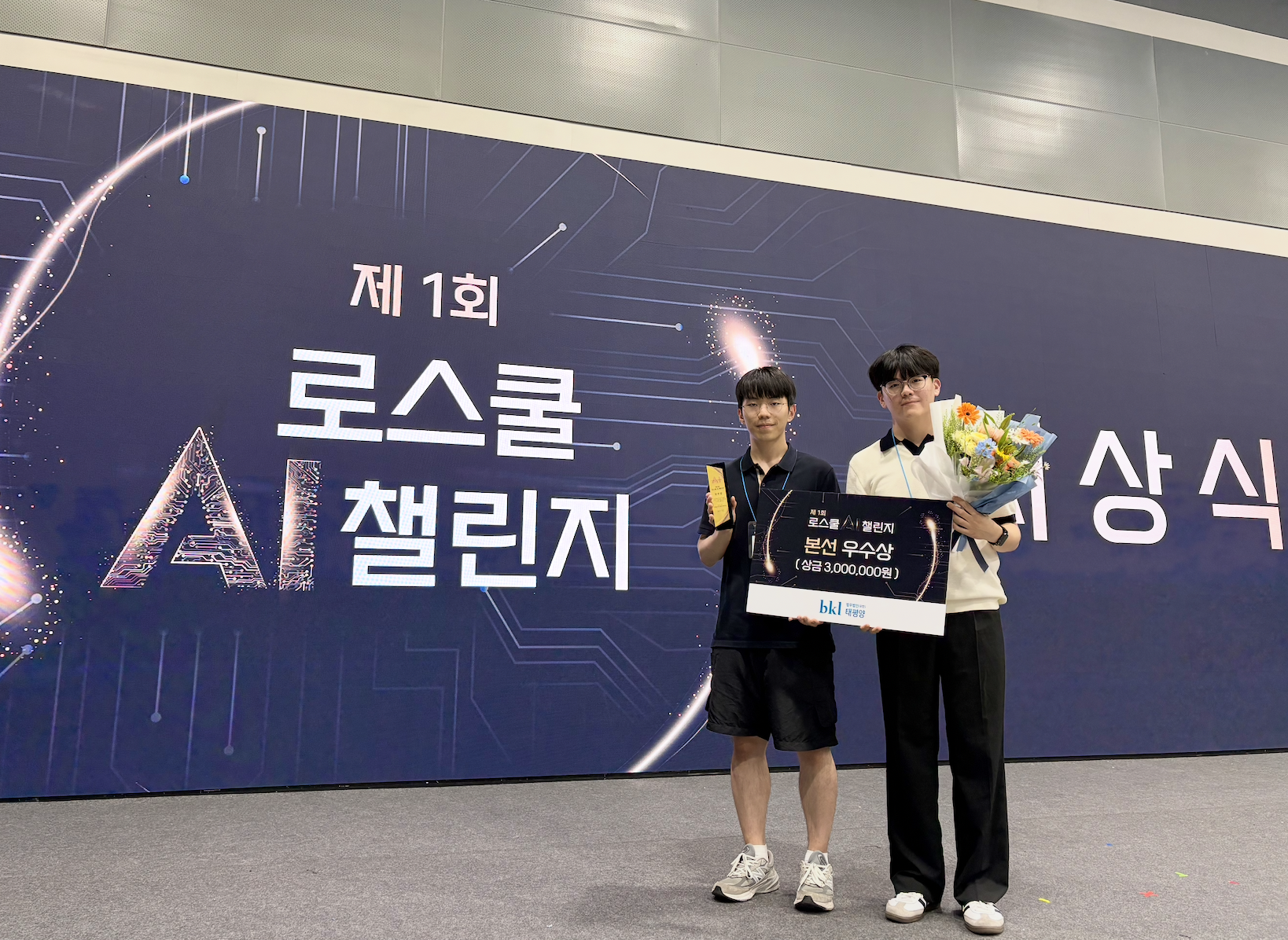
Then came the awards ceremony. After the congratulatory remarks, which were filled with the reflections of senior legal professionals on the AI era, the main-round excellence awards followed. The moment I heard the words “Bae, Kim & Lee,” my heart began to pound. A moment later, our team name was called. Among the teams that had received the Bae, Kim & Lee problem, we had received the highest evaluation and won the main-round excellence award, the Bae, Kim & Lee Managing Partner Award.
I was indescribably happy. We did not win an award in the final round, but the fact that our main-round answer had been rated highest among the teams assigned the Bae, Kim & Lee problem was more than enough. I think I will remember for a long time that two first-year law students, just one semester into law school, used AI tools to draft a legal opinion on a serious corporate advisory matter in three hours, and that practicing lawyers at a major law firm evaluated it favorably.
Closing thoughts
AI is fast. But speed alone does not make it something we can rely on completely. AI suggests many things, but the final decision and the responsibility for that decision still belong to human beings.
The work of legal professionals can no longer remain limited to simply “finding” materials. What will matter more is the ability to judge which materials are important, identify issues AI has missed, verify sources, and turn information into actionable language that fits the client’s situation. I came away thinking that these are precisely the abilities future lawyers will need. The judges also emphasized that highly evaluated answers were those that corrected nonexistent cases or inaccurate statutory references produced by AI, cross-checked multiple AI tools, and completed the legal reasoning through human review.
Through this competition, I came to see more clearly the qualities that lawyers need to develop in front of AI: the ability to ask good questions, the tenacity to verify answers, the strength to structure complex facts, and the sense of responsibility to transform technological efficiency into judgment for people. Above all, I was reminded that what clients need is not a polished sentence that merely sounds convincing. They need a judgment they can trust.
Our team name was jokingly “AI Did Everything.” But by the time the competition ended, I had reached almost the opposite conclusion. AI had not done everything. AI helped us a great deal, and because of that help we were able to go further. But the final sentences were chosen by us. The dangerous conclusions were filtered out by us. The decision about what would be the most responsible course for the client was, in the end, made by human beings.
The First Law School AI Challenge left me with a question larger than the award itself. In the face of the enormous change brought by AI, what should legal professionals learn? And no matter how far technology advances, what will remain the work that only a person can do? I do not yet know the full answer. But one thing has become clear. The lawyers of the future should not be people who fear AI. They should be people who understand AI precisely, verify it with a cool head, and complete the work through human judgment.
I am grateful to have stood at the beginning of that path. This challenge will stay with me for a long time.